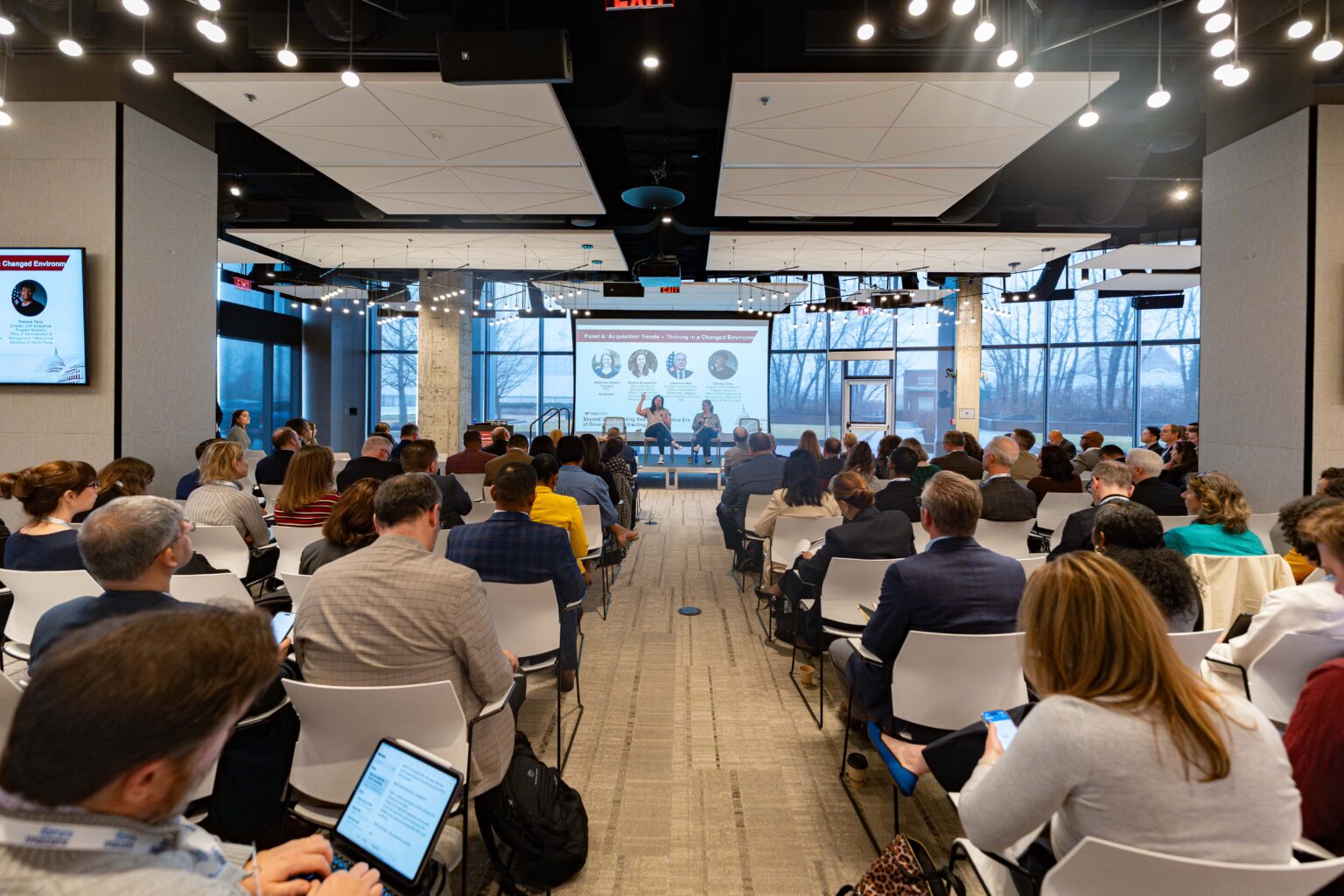
More than 200 government contracting leaders gathered in Tysons, VA, for Beyond 2026, Red Team’s second annual conference focused on the forces reshaping the federal market. Executives and government leaders spent the morning examining the structural shifts changing how companies compete, grow, and build enterprise value in the federal sector.
One theme ran through every discussion: resilience is a strategic growth capability.
Companies that thrive in the next phase of the market will design portfolios, operating models, and growth strategies that allow them to adapt quickly as policy, budgets, and mission priorities evolve.
Below are several market shifts shaping how leaders across the industry are responding today.
1. Resilience Must Be Designed into the Business Model
Resilience is about maintaining strategic freedom when the market shifts. Speakers emphasized that companies must build contract portfolios and operating models that ensure they never run out of options when budgets tighten, or acquisition rules change.
Several factors are becoming central to that effort:
- Contract structures that stabilize revenue and cash flow
- Modular teaming models that scale with funding changes
- Investment in repeatable capabilities rather than labor-based delivery
In other words, resilience is engineered long before disruption occurs.
2. The Market Is Moving from Labor to Capability Platforms
Across agencies, expectations are changing.
Customers increasingly expect contractors to deliver repeatable capability platforms supported by tools, methods, and intellectual property. Traditional staff augmentation models face growing pressure, particularly in professional services environments.
This shift requires companies to think differently about offerings, internal investment, and the structure of their delivery teams.
Organizations that continue to rely primarily on labor-based services will face increasing margin pressure over time.
3. Policy Signals Are Market Signals
Many of the most important shifts in the GovCon market are being driven by structural pressures inside government.
Contract consolidation, commercial technology preference, and acquisition reform are not isolated policy initiatives. They are responses to challenges facing the acquisition workforce, including workload pressure, source-selection complexity, and the pace of technology change.
Companies that treat policy developments as strategic market intelligence position themselves to move earlier than competitors.
4. Business Development Is Becoming More Technical
One of the most candid discussions at Beyond focused on the evolution of growth organizations. Traditional relationship-driven business development models are giving way to something more complex.
Growth teams increasingly need:
- Technical credibility in customer conversations
- Deep understanding of mission environments
- Close integration with engineering and solution teams
Speakers described this shift as moving from customer intimacy to mission intimacy, where competitive advantage comes from understanding operational challenges in detail rather than relying solely on relationships.
5. Enterprise Value Is Being Judged Differently
The conference closed with a discussion of capital markets and M&A trends across government contracting. While transaction activity fluctuates with broader economic conditions, investors remain highly interested in companies with durable positioning.
Buyers are rewarding firms that demonstrate:
- Concentrated mission depth with key customers
- Differentiated intellectual property or analytics capability
- A proven ability to compete in full-and-open environments
- Resilient growth during market turbulence
Companies heavily dependent on set-aside work or narrow customer portfolios face a smaller universe of potential buyers and lower valuations.
For leadership teams considering a future transaction, preparation begins years before a deal.
The Conversation Continues
Beyond 2026 reinforced something many leaders already recognize: the government contracting market is going through a period of structural change. Companies that treat strategy as a static plan will struggle to keep pace.
The companies that succeed will treat strategy as an operating discipline. They will invest ahead of opportunity, adapt quickly to policy signals, and design business models that allow them to move when there are market shifts.
Planning is already underway for Beyond 2027, where leaders across the GovCon community will gather again to examine the next phase of the market. If this year’s discussions were any indication, the conversation is only getting more important.
Stay tuned for details on next year’s event and subscribe to our newsletter.